Local community Kalemie

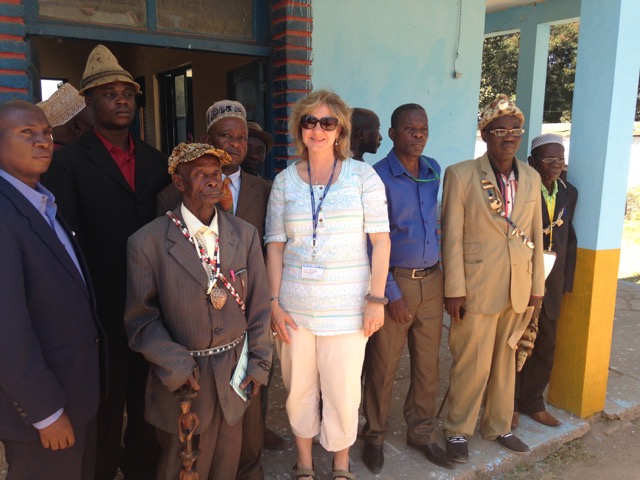
These were my first meetings with the local community in Kalemie – so no helicopter ride this time.  I especially enjoyed meeting the “chefs coutumiers” – the traditional village chiefs”, who explained to us the security and protection issues they are dealing with in their areas. They spoke in Swahili, which was translated into French. Men and women work tirelessly for the protection of their communities, with very limited state assistance and against great odds.

On the job – and treats from Goma

Our latest field trip yesterday was a “JAM” (Joint Assessment Mission with other Sections) to a very remote village in the area of Manono, some 500km south west of here. We were going there to attend a “baraza”, a Swahili word for a public meeting, in this context a gathering of communities in conflict to hold dialogue and search for peaceful solutions. This initiative in our area was developed by Civil Affairs and has been singled out recently in the UN as an example of best practice in the field. This particular baraza is related to the Luba-Pygymy conflict in the area. We were joined on the ground by local authorities and security forces and representatives of civil society in the area, as well as one of our Community Liaison Assistants (CLAs) who facilitated the visit.

We took two helicopter flights this time: Kalemie – Manono (1.5 hours) then Manono-Mbayo (half hour). I wasn’t prepared for the heat and realised again that I can’t count on Maheshe at all to brief me on practical issues of his own volition! Whilst I’d packed my first aid kit and wore my trainers, I should have worn my walking boots, I forgot my hat, had too little water, packed chocolate (which melted inside my rucksack) and no sandwiches for a rather gruelling 10-hour round trip.

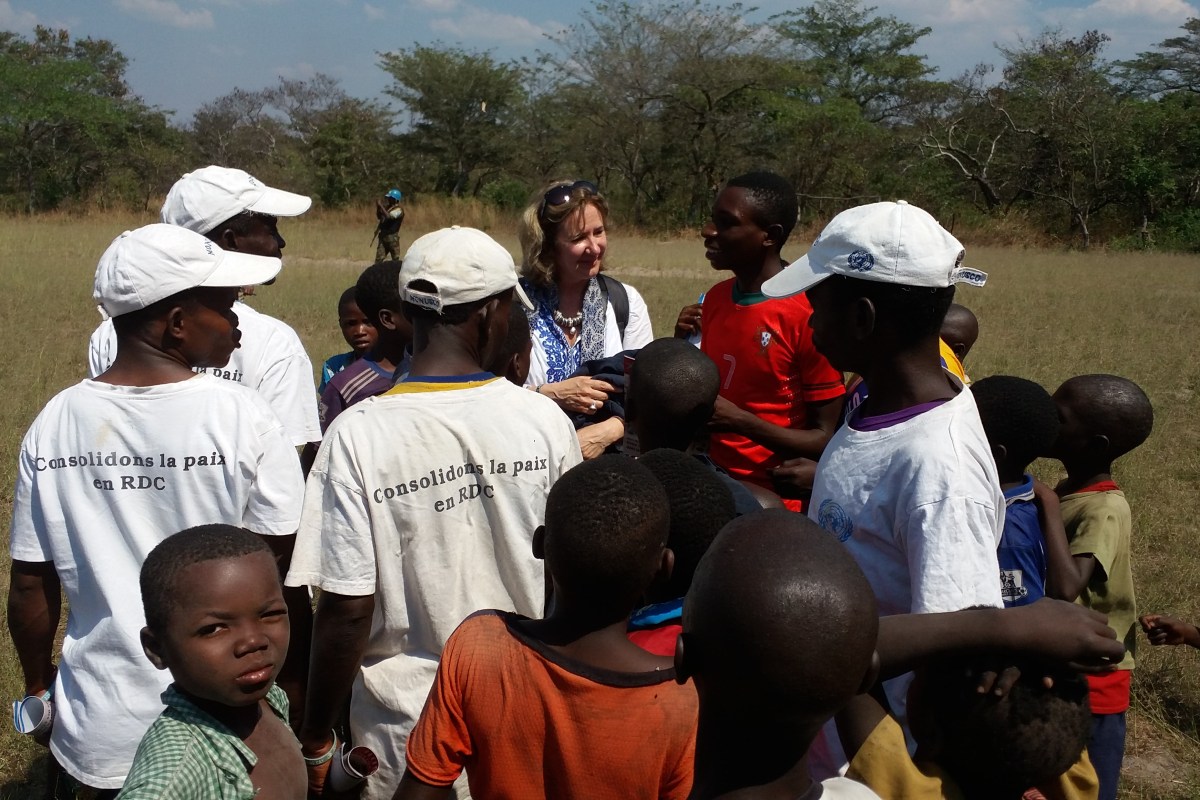
I also wasn’t prepared for the starkness of the village, which had been all but destroyed by the conflict and people had only recently been returning. It was abject poverty; literally next to nothing. I felt a squirming discomfort at the absurd contrast with our affluence, and being photographed with the project banner at the end of the Baraza (imposter syndrome creeping in again). As much as I love my Congolese tandem and marvel at his knowledge of the field, I also wanted to throttle him for not thinking to bring stuff with us. The children were asking us for pens, and a football. Can you imagine, they don’t even have ONE football in a village of about 1,000 people! The “school room” made me cry, with its rickety broken benches and dirt floor. A teacher had chalked French straight onto the stone wall; not even a blackboard. Next to it is the unfinished new school, that has no roof. We will coordinate with the humanitarian agencies to see what they are doing there. I just hope it doesn’t get lost in the bureaucracy and take forever. As the UN’s peacekeeping and stabilisation mission, we are tasked with the more political and human rights/protection aspects; how to give communities the support and confidence they need to continue their conflict resolution and organise to get the provincial state authorities to really give a damn about them. The Barazas are part of this.

Members of the village stood up to speak in their own language (Luba – which is a Bantu language and one of the main languages of DRC along with Lingala, Swahili and Kikongo), which was translated into French for us. Jacob, our Head of Office, spoke to them in Swahili (he’s Kenyan), which they partly understood but was also translated into Luba – and then French. Jacob questioned why there were so few women present and why none of them had spoken. So then three different women were encouraged to come to the front and speak. Two of them were timid and folded their arms self-consciously across their (clothed) breasts. It struck me how universal is the struggle for women to make their voices heard and be listened to! The men started talking while they were talking, which they hadn’t done up until then when other men had been talking. Again, Jacob pulled them up on this and insisted they be quiet.

I strained to follow the thread of the dialogue consistently, preferring to try and understand the French translation to having a second translation into English. I was distracted by the surroundings: the chickens and ducks pecking and squawking in the dusty earth, the ragged clothes of the children, and then wondering why anyone would want to wear a woollen hat in that heat!! A boy in his late teens in a bright red Manchester United shirt with Ronaldo on the back also spoke. I could tell he was highly articulate and indeed as we were accompanied on our way back out of the village, mainly by excited but shy children, he was able to communicate in French with me. But not a word of English. The teacher in me wanted to stay behind. One little boy stuck very close to my side and as we were approaching the helicopter, plucked up the courage to ask me if I had a pen he could have. My heart snapped in two, because I only had one pen and I couldn’t give one without the others. Damn. One of the military guys inadvisedly thrust a packet of sweet wafers towards them, which almost caused a riot.

Back in my room, I had a bit of cheese and stuff from my “care package” that arrived from Goma on Monday. My German colleague, Miriam, did me proud, bless her! I never thought I could get so excited about the prospect of cheese and salad! And yoghurt. She packed the cool box full of stuff, including the most enormous avocado I’ve ever seen, perfectly ripe and creamy. And lots of chocolate 😉 It is possible to find more vegetables in Kalemie than those on offer at the cafeteria – but you have to know where to look, and I haven’t explored enough yet. I seem to be always working, and this malaria is hanging around and making me dog tired. Another course of treatment ahead…

This slideshow requires JavaScript.


My first full week

I discovered that I am “allowed” to go out of the compound, although strongly advised not to wander alone outside of daylight hours. So both yesterday and today I went out at 6.30am and walked briskly up the (one and only) road along the lake towards the airport. Just 15 minutes each way, then I did some free-style stretching back in my room. It’s good to be walking on that road, confronted with the reality of people going about their business. The road is not that wide and is two-way, so with cars, many taxi motorbikes and pushbikes and pedestrians on both sides, you get to pass people very close up. Everyone looks at you in the face and most people greet me, and I greet them back. If they say “bonjour”, I say “bonjour”; if they say “jambo”, I reply in kind. The faces of those who don’t greet me haunt me somehow. What a scourge this poverty.

“Business” for many at that time of the morning entails schlepping heavy containers of water on their heads from the lake; mostly women and children. The sheer physical exertion I see all along this long road that runs the length of the town is something that strikes me: men and boys pushing bikes of all shapes, sizes and material laden with heavy goods, like planks of wood, sacks of rice; women with large loads and children on their heads/backs respectively. In the car yesterday, we passed the same overturned truck in a ditch from the day before, only this time, a group of men were using wooden poles and other improvised contraptions to lever it out. The morning air is thick with smoke from burning grass and wood. Whole families wobble past on one bicycle. I think the greatest risk of walking out on my own is being hit by a vehicle of some description.

Back to my first weekend: on Saturday, I eventually emerged from the confines of the compound. The road leading into the town is dusty and full of potholes which my still delicate back didn’t appreciate. It seems to go on forever, and the scenery on each side is very samey: shops, many just a concrete shell, selling no end of cheap Chinese goods. There are make-shift markets interspersed, which consist of a rather unvaried selection of fruit and vegetables. I spotted a woman selling pineapples, so bought one plus some bananas and oranges, then some papayas and avocados from just outside the compound from Kalemie’s version of a pop-up. Apparently the avocados and other fresh stuff like cucumbers (hard to find) come over from Tanzania – a paradise, apparently, compared to here. I’m sure the soil is not easy here, but land rights issues and the de-development caused by years of war, conflict and corruption, have fucked agricultural production – along with the rest of the economy. At the same time, the gold and other mineral diggers get rich and build their luxury houses, which then get broken into and looted.

As we got to the far end of town where it starts to rise up onto the “colline d’état”, we passed house after faded house built in the Belgian colonial era. It was so eerie. I’ve never been to Cuba but I don’t think it would be a good comparison, as I’d imagined before I came. These houses are mostly falling apart and you’d imagine empty with the boarded up windows. But they are inhabited. So many light bulbs outside the houses were on in the middle of the day! At the top of the hill, there is a rusted canon from the First World War and other war machinery. My head was spinning by this point, because the view from the hill over the lake with the red, pink and white blossom-filled trees, was intoxicatingly beautiful. This should be a paradise; and it probably once was. Now it’s miserable: few proper roads, degenerated mains water system, no reliable electricity supply, disease-infested hospitals and a shortage of fresh food. We then went down to the old port: more rusted icons from a by-gone age. And the tracks once heralding the fine railway system overgrown. There were women bent double harvesting dried grass and small children peddling wares. A lot of men idling around under trees.

Sunday morning I joined some of my Congolese colleagues for Sunday mass at the Catholic “Albert’s Church”, bumping our way along the whole length of the town again. I was told it would only be just over an hour but it was a solid two hours and I found it somehow oppressive. Perhaps because I couldn’t follow it all. With the exception of some nice singing by the choir, it was a bit of an endurance test. The children were amazingly “well-behaved” (as in quiet and non-fidgetey), all turned out in their Sunday best. I was distracted by the extreme range of volume and pitch of the priest’s voice during his sermon, which reminded me of tele-evangelists, even though apparently what he said was sound. Suddenly, a man who had been wandering in and out and disturbing people in the pews, seemingly confused and dazed, was yanked by the arm by a fellow worshipper and hauled unceremoniously to the door at the back. I tried not to make a value judgement, but I found myself upset and dismayed at such a spectacle, and terribly homesick for lovely St. James’s in Piccadilly.

Monday morning I went on my first field trip to the rural area of Bendera – 120km north of here. It was my first time in a helicopter – just half an hour’s ride. It’s not particularly comfortable and you really need the earphones, but I enjoyed the views. When you fly over the Congo, you are struck by the vast swathes of seemingly uninhabited terrain. We were picked up and taken straight to the military base run by “Benbatt” (= Beninois Battalion) where our two Community Liaison Assistants (CLAs) are based – both young men. The Mission area for Kalemie has five bases altogether, and 10 CLAs plus two coordinating CLAs based with us here on the compound in Kalemie. We were given a presentation of the current conflict issues going on in the area, ranging from an influx of Rwandan refugees, to Pygmy-Luba battles, to abuses by (often unpaid) government security forces. They had also brought in a small group of (all male) civil society representatives and the local governor, the “Chef d’Antenne”. Sadly we had less than two hours to visit because the helicopter had to get back to Kalemie to go somewhere else (a last-minute scheduling).

I’m supposed to be joining a joint assessment mission to another area next Tuesday; just hoping I will be fit. I’m now starting to feel very hot, but it might be because my office is stuffy, and I don’t want to sit in any more air con today. So deep breaths and back to my room to down the first four of my malaria treatment tablets. Yes: I have malaria! I’m rather discouraged about this, given that I’ve been so careful in covering up and spraying that nasty deet stuff onto my skin. I haven’t been aware of any mosquitoes buzzing around me in my room and I’ve been tucked under my net. But apparently they’re everywhere, even during the day, and the females who carry the malaria don’t buzz. I went for the quick finger pin-prick blood test after noticing a very strange, stiff and heavy feeling in my legs. I had a temperature of 38.8 but had been waking up feeling cold in the night. Apart from that, I can’t say I was feeling especially ill. But it’s the longer-term implications of not treating malaria properly that are more worrying.

This slideshow requires JavaScript.

Arrival in Kalemie

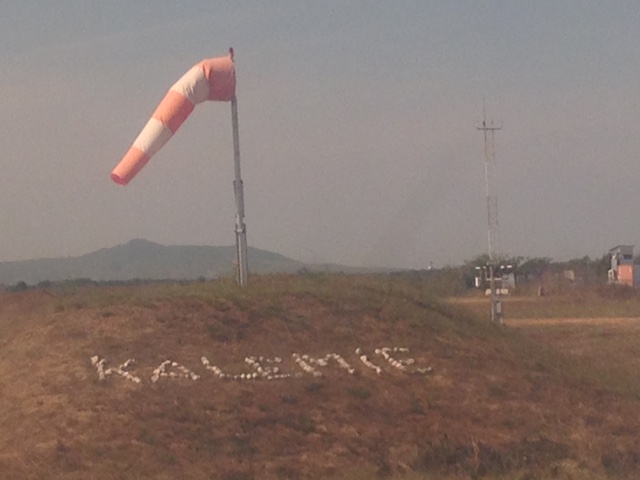
Landing on the narrow red-soiled airstrip next to the lake in Kalemie felt like arriving in a different country (it’s just under 500km south of Goma, still in the east). I wondered as we descended about the numerous plumes of smoke rising from the forests of trees below. I later realised this was the reality of the “slash and burn” process used in the dry season to clear land for agricultural use, which has led to desertification and increasing food insecurity. It wasn’t quite “The Poisonwood Bible”, and I didn’t attempt to wear half my wardrobe, but I did labour under the weight of my too-heavy hand luggage. The heat hit me as I stepped off the tiny UN plane (seating about 20), but it was offset by a bracing breeze off Lake Tanganyika – the second largest freshwater lake in the world by volume and depth (after Lake Baikal in Siberia). My Congolese “tandem”, Maheshe, was there to meet me. The UN compound is about a 5km drive down the straight road from the airport. The requested room in the “guesthouse” – comprising a double row of adjoined pre-fab rooms facing each other – had not been prepared for me, but I was bundled into an end one on the side that has en-suite bathrooms.

Maheshe took me over to our Civil Affairs offices – again pre-fabricated containers – a stone’s throw from the lake. He opened the room of my office, and it was completely bare: no furniture; no computer; NADA. He seemed to find this amusing. I took a picture of it. Welcome to Kalemie! We were late for the start of the annual workplan workshop at 3.30pm, less than an hour after my arrival. Do they have no mercy, I wondered.

The workshop went on until 6pm. Most of the discussions were in French, and mostly I was in the semi-darkness, taking note of the fact that there were only three women in the room – including the facilitator from Goma. There was a cluster of Cameroonian “mafia” – as I like to call them – who generally misbehaved (the school teacher in me observed), but everyone was friendly enough. Jacob, the Kenyan Head of Office – nearly always speaks English – even though his understanding of French is obviously very good. He is very courteous and easy-going, and clear in what he says.

Following a meal in the cafeteria of fried fish, home-made chips, plantain and some kind of spinach-like green called “Amaranthes”, my sparse, army barracks-style room awaited me Monday night with its uninviting neon strip-lights and dribbling water. I climbed nervously under the mosquito net already erected around it, and my heart sank along with my body into the big dip in the middle of the mattress. I was so exhausted, I slept anyway. As I fought my way back out from under the net next morning and stood up, the muscle on the left side of my lower back went “ping”. Two weeks of travelling and hauling heavy luggage around had taken its toll. As I held the trickle of water from the shower head over my weary, stiff body, I wanted to cry. I didn’t even bother to try and wash my hair. It felt like purgatory having to sit through eight hours of the planning workshop day two. African French is something else. I’m getting used to the ‘je pAnse” but of course am too snobby to adopt it! I tried to look as if I knew what was going on, but mostly I didn’t. Although there were one or two points of light when I took the opportunity to make a contribution or two – it’s a bit early to blow my cover.

They changed my mattress on Tuesday, but the damage was done. By Thursday, my back was in spasms and I could hardly walk. Jacob wanted me to see the doctor and/or go to see the Catholic nuns down the road who are famous for their massage! I couldn’t handle even the idea and insisted that I just needed to rest and take painkillers. I got Maheshe to send the IT guys over with my new lap-top so I was at least able to drop my folks a line. Then I slept for the rest of the day and night.

Miraculously, when I woke up Friday morning, my back felt almost back to normal and suddenly everything felt more manageable. I was so relieved. I attended a meeting in the morning about protection of civilians, and made it over to the OCHA (the main UN agency for humanitarian affairs) office down the road for an introductory meeting with the team there. They have a proper building which seemed palatial! But it’s being swallowed up by the encroaching lake which has been roaring all week with high waves from the strong winds. We have been warned by security not to go near it.

The large and unsalubrious cafeteria is the hub of the compound, with its rather cheerless provisions. It has tinsel on the walls, a small pool table at one end and a big flat-screen TV at the other (which usually has football on). A long bar runs between the two ends along one wall with a door through which the staff – three or four young men – disappear to a kitchen down the corridor and take up to 15/20 minutes to reappear. Its redeeming feature is that it sells cold, locally brewed beer – “Simba” – which is very good, and cheap. The working week on the compound culminates in the “happy hour” in the cafeteria on Friday evening. The atmosphere was marginally happier, I conceded, with some danceable music. I joined a table where the compound’s doctor was seated with a quietly spoken colleague from South Sudan.

“Doctor Lucy”, half Filipino, half Chinese, is diminutive in stature and huge in character! They call her “Doctor Bananas”, also because eating fruit is included in all her prescriptions for all illnesses and ailments. I ended up on the dance floor with her and an eclectic group of others, including Congolese civilian staff and Beninois soldiers, who constitute the UN military force here. Apparently she has a nice house in the designated area behind the compound with very good guards and security which she said she will be vacating in September. She’s done it up and has a proper cooker! So if I don’t manage to find anywhere decent (and there seems to be a shortage of appropriate housing stock), I might take that – but I haven’t seen it yet.

Image

The Odyssey (well not quite…)

Following the six weeks’ arduous preparations for departure: endless form-filling, vaccinations, gathering of supplies and getting my flat ready to rent (not to mention the many reluctant good-byes), I arrived in my hotel in Brindisi weary but relieved at five minutes to midnight on Sun 22nd May. When my alarm went off at 6 next morning, I wondered how on earth I was going to make it through the day, let alone the week. However, being in Italy – one of my “home from home”s – turned out to be a real tonic, even if we were obliged to be at the Italian airforce compound (where UN Department for Peacekeeping Operations has its main training base) from 08:30 to around 17:00 every day. It felt like a kind of mini-vacation, being by the sea and dining out by the port every evening. Brindisi has been transformed since I passed through there as a student 29 years ago on an inter-rail ticket to cross over on the ferry to Corfu (feeling old).
The “Civilian Pre-Deployment Training” (CPT) exceeded my expectations, which admittedly had been low. It was a good bunch of 22 people from all parts of the globe, and I was by no means the oldest! I found it well-organised and extremely informative, despite the odd “death by PowerPoint” session. I enjoyed the sense of camaraderie, and so appreciated the course organisers who went out of their way to assist us with everything possible. Perhaps the high (or low) point was the simulated ambush of our three-vehicle convoy by masked gunmen, firing blank but frighteningly real-sounding bullets. Even though we had a good inkling of what was to come, it was still terrifying, and most of us forgot to do key things, like press the red alarm button on our radios. I’ll spare you the other details. Suffice to say I really hope it never comes to that.

CPT finished Friday afternoon, then a group of us made the short train ride over to the beautiful Baroque city of Lecce, for an all-too-brief but very enjoyable stroll around the cobbled streets, popping into a couple of churches before sitting down to gelati and aperitivi. As I wasn’t leaving Brindisi until Saturday evening, I treated myself to a massage in the hotel (Orientale), which was heaven. The effects seemed to dissipate fairly quickly though with the marathon next leg of Brindisi-Rome-Abu Dhabi-Entebbe overnight, arriving in Entebbe just after mid-day Sunday 29 May. I produced on demand my Yellow Fever vaccination card and duly entered sub-Saharan Africa for the first time. Entebbe was green, pleasant and clement. It was the end of the rainy season. The first thing I noticed was that they drive on the left. Hotel Lake Victoria was a bit of a step down from the hotel in Brindisi (although not in price), mainly due to rather dank rooms with fitted carpets that had seen better days. On the plus side, the breakfast was good and there was a large outdoor swimming pool, of which I availed myself two out of the three early mornings.

The two days’ “check-in” in the Entebbe Regional office was rather painless. It consisted of being guided through another raft of form-filling and sitting around in between. The highlight of Entebbe was enjoying a barbecued fish feast on a tiny beach on the shore of the lake one evening with the lovely Miriam, my German colleague posted to Goma. I tried out my (apparently) state-of-the-art deet-free “TREK” insect repellent, and it seemed to work. I’m a bit worried I might run out though at the rate I’m using it here. I’m rather paranoid but as it’s malarial, I think it’s better to be so.

What wasn’t so relaxing in Entebbe was having to repack my two large suitcases as they informed us we couldn’t take more than one 20kg bag with us on the UN flight to Goma – aargh! I’d taken pains in London to split my supplies evenly between the two cases to not get caught out in the event of loss having all my knickers in one basket, as it were. With a sense of resignation, I handed over 37kg of stuff to the “MOVCON” warehouse in Entebbe to be sent on as cargo to Kalemie, which might take weeks, I was told.

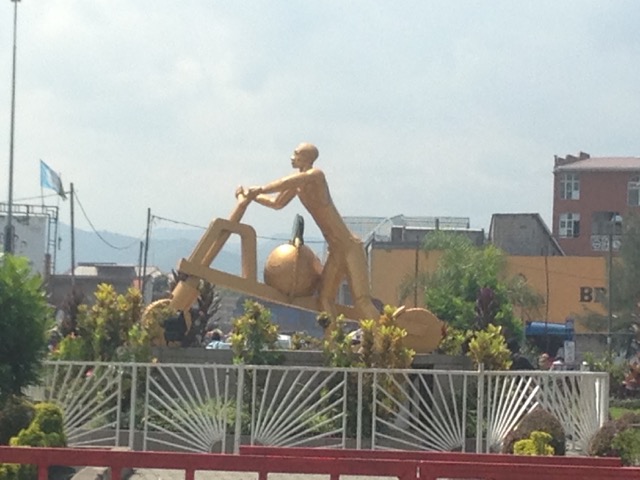
The flight from Entebbe to Goma – squashed in with some less than sweet-smelling military guys – was less than an hour. We touched down in the pouring end-of-wet-season rain (I’d packed my umbrella in the cargo bag) and a cheerful Congolese colleague from Civil Affairs in Goma HQ, was there to meet me. We proceeded along the unpaved road from the airport with its stupendous potholes, being jolted around despite my colleague’s caution. Most of Goma’s roads were destroyed in the lava from the big 2002 eruption of Mount Nyiragongo, menacingly located just 12km from the city. I was transfixed by Goma’s famous wooden bikes known as “Chukudus” (stress on the first syllable), with their massive loads. Huge handlebars, clumpy wooden wheels, no seat, but instead a knee-rest, and ridden with more of a scooter rather than a bicycle motion. The riders were invariably young, sinewy men. There is a golden Chukudu monument in the island of one of the main roundabouts – a great landmark.

Comfort levels took a nosedive when I arrived at the Jerryson Hotel up a bumpy, muddy side-road not far from the offices where I was to have my briefings. Dreary and noisy. The hotel is being extended upwards so it felt like a building site. The bathroom door kept jamming and I didn’t get to sleep until about 2am due to noisy guests and music blaring out from a “nightclub” down the road. My only comfort was being able to make tea in my room using my travel kettle. Sadly, the only coffee available was yukky instant powder, along with powdered milk. Again, I’d packed my filter coffee and cafetiere in the cargo bag. The next morning, between briefings, I checked out and migrated down the road to the much better “Linda Hotel”, literally right on the lake. So much so that I felt we were IN it!

I discovered my briefings in Goma HQ would start Wednesday afternoon at 2.30pm and I was plunged into a video teleconference in French, where my Kalemie colleagues-to-be appeared on the screen. I felt rather clueless with my rusty ‘A’-level French, and had I not been so exhausted, I might have felt embarrassed. Nonetheless, the two days of briefings with the Goma HQ Civil Affairs team were very useful indeed. My tendency not to read the small print has to go down in (my) history this time. I realised I was going to be head of section – or “Officer in Charge” for Civil Affairs in Kalemie, rather than the minion I’d supposed, being my first UN mission. No pressure…

I was supposed to leave Goma on Friday 1st June, but arrived at the airport to find the UN flight to Kalemie had been cancelled. A real blessing as it turned out, as I joyously got to stay the weekend with Solange, a friend of my dear friend Catherine from Palestine and Beirut days. Solange is half Italian, half American, grew up in Italy till age 14 then was educated in the UK. She’s a pretty damn feisty woman (ten years my junior) and has been back and forth to eastern DRC for the past 8 years, now finalising the field research for her phD on armed conflict. She is staying in a lovely apartment in an idyllic setting by the lake. Finally I was able to rest, sleep and eat lots of fresh fruit and vegetables – as well as pick Solange’s ample brain about DRC. I knew I had to make the most of this little reprieve and oasis.